

Introduction
Few matchups in Major League Baseball deliver as much intensity, unpredictability, and statistical depth as the Toronto Blue Jays facing the Boston Red Sox. These two American League East rivals have built a history of dramatic games, late-inning heroics, and standout individual performances that often define entire seasons.
When fans and analysts study toronto blue jays vs red sox match player stats, they are not just reviewing numbers—they are decoding strategy, momentum shifts, and the hidden layers that determine victory or defeat.
In this expanded deep-dive analysis, we explore batting performance, pitching matchups, defensive execution, advanced metrics, and long-term trends that define this iconic rivalry.
Understanding the Rivalry and Its Competitive Edge


The rivalry between Toronto and Boston has evolved into one of the most competitive in the AL East. While Boston has a long-standing championship pedigree, Toronto has emerged as a young, aggressive, and offensively powerful contender.
Modern toronto blue jays vs red sox match player stats show that the gap between these teams has significantly narrowed in recent seasons. Games are no longer one-sided; instead, they are defined by fine margins such as bullpen efficiency, situational hitting, and defensive execution.
This rivalry is fueled not only by standings pressure but also by stylistic contrast. Toronto thrives on power hitting and explosive innings, while Boston emphasizes consistency, contact hitting, and adaptive pitching strategies.
Game Tempo and How It Shapes Performance
One of the most overlooked aspects of baseball analysis is game tempo. The pace at which innings unfold has a direct impact on player performance.
In reviewing toronto blue jays vs red sox match player stats, it becomes clear that early momentum often dictates how aggressive or conservative each team becomes. If Toronto scores early, they tend to lean into power hitting and bullpen protection. If Boston takes the lead, they often slow the game down through pitch control and long at-bats.
This strategic tug-of-war makes every inning critical, especially in tightly contested games.
Deep Dive Into Batting Performance
Batting is where fans often see the most excitement, and both teams deliver in different ways. Toronto is known for raw power, while Boston is known for disciplined, high-contact batting sequences.
When analyzing toronto blue jays vs red sox match player stats, batting splits against right-handed and left-handed pitching become extremely important. These splits reveal how managers construct lineups and adjust strategies mid-game.
Toronto’s middle order often delivers high slugging percentages, while Boston’s lineup tends to maintain a steady on-base rhythm throughout all nine innings.
Power vs Consistency: The Core Difference
Toronto’s offense is built around home runs and extra-base hits. Players like Vladimir Guerrero Jr., Bo Bichette, and George Springer often change games with one swing.
Boston, on the other hand, relies on extending innings. Walks, singles, and situational hitting define their offensive identity.
This contrast makes toronto blue jays vs red sox match player stats especially interesting because both approaches can succeed depending on execution and pitching conditions.
Advanced Batting Metrics That Matter
Modern baseball is driven by analytics, and traditional stats like batting average are no longer enough.
Key metrics that appear frequently in toronto blue jays vs red sox match player stats include:
- OPS (On-base Plus Slugging)
- wOBA (Weighted On-Base Average)
- Launch Angle
- Exit Velocity
- Hard Hit Percentage
Toronto often ranks higher in exit velocity and slugging metrics, while Boston tends to perform better in contact rate and strikeout avoidance.
These differences explain why Toronto games often feature high-scoring bursts, while Boston games remain more controlled and tactical.
Pitching Matchup Breakdown and Game Control
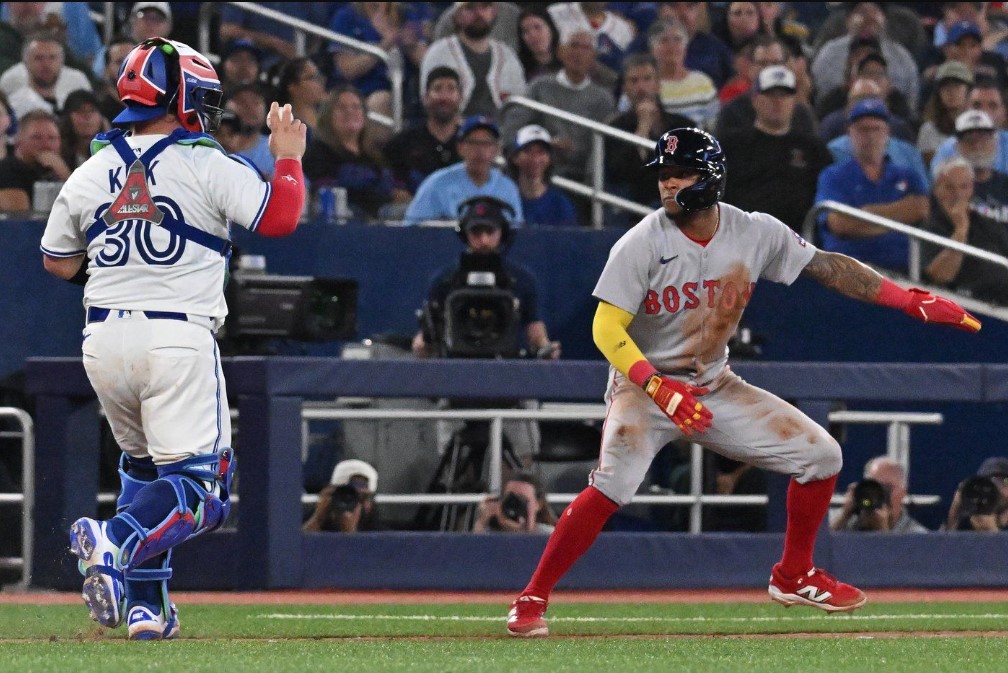
Pitching is the backbone of any baseball game, and in this rivalry, it often determines the final outcome.
Starting pitchers set the tone, but bullpen reliability becomes the deciding factor in close games.
In analyzing toronto blue jays vs red sox match player stats, strikeout-to-walk ratio (K/BB) is one of the most telling indicators of performance quality.
Toronto pitchers often rely on high-velocity fastballs and sharp breaking pitches, while Boston pitchers emphasize control, pitch placement, and ground-ball generation.
Starting Pitchers vs Bullpen Depth
Starting pitchers usually perform well through the first few innings, but fatigue becomes a major factor in the middle innings.
Toronto’s rotation tends to produce higher strikeout numbers but may struggle with pitch efficiency, leading to early bullpen usage. Boston starters typically aim for deeper outings with fewer pitches per inning.
Bullpen performance is where games are often won or lost. Late-inning relievers with low ERA and high strikeout capability frequently appear in toronto blue jays vs red sox match player stats as key game-changers.
Pitching Performance Comparison Table
| Category | Toronto Blue Jays | Boston Red Sox |
|---|---|---|
| Average Starting ERA | 3.60 – 4.30 | 3.40 – 4.10 |
| Bullpen Stability | Inconsistent under pressure | More structured late innings |
| Strikeout Rate (K%) | High (power pitching approach) | Moderate (control-focused style) |
| Walk Rate | Slightly higher | Lower overall |
| Fastball Velocity | Above league average | League average |
| Defensive Support Impact | Strong outfield coverage | Strong infield coordination |
This table highlights how evenly matched both teams are, even though they approach pitching from different philosophies.
Defensive Execution and Fielding Impact
Defense often goes unnoticed, but it can completely shift momentum in close games. A single error can extend innings and lead to multi-run consequences.
When reviewing toronto blue jays vs red sox match player stats, fielding percentage, defensive runs saved (DRS), and error counts become essential indicators.
Toronto’s outfield defense is particularly strong, often preventing extra-base hits. Boston, meanwhile, excels in infield coordination and double-play efficiency.
Clutch Performance and High-Pressure Situations
Clutch performance is one of the most fascinating aspects of this rivalry. Late innings often define the outcome, and players who perform under pressure become legends in these matchups.
In toronto blue jays vs red sox match player stats, clutch hitting is measured by performance with runners in scoring position (RISP) and late-inning RBI contributions.
Toronto tends to rely on power hitters in clutch moments, while Boston emphasizes strategic hitting and plate discipline.
Situational Hitting Breakdown
Situational hitting refers to adapting batting strategy based on game context.
Examples include:
- Sacrifice flies to score runners
- Hit-and-run execution
- Opposite-field hitting under defensive shifts
Boston typically excels in situational awareness, while Toronto relies more on raw offensive force. Both approaches are effective depending on execution timing.
This contrast makes toronto blue jays vs red sox match player stats especially valuable for predictive analysis.
Managerial Strategy and Tactical Decisions
Managers play a critical role in shaping outcomes through real-time decisions. These include:
- Pitching changes
- Defensive shifts
- Pinch hitters
- Batting order adjustments
Every decision impacts momentum and can be traced through toronto blue jays vs red sox match player stats, especially in late innings where matchups become highly specialized.
A well-timed bullpen switch or pinch-hit appearance often determines whether a game is won or lost.
Momentum Swings and Psychological Pressure
Baseball is unique because momentum can shift instantly. A single home run, defensive error, or strikeout can completely change a game’s direction.
When studying toronto blue jays vs red sox match player stats, momentum shifts often align with scoring bursts or pitching collapses.
Home-field advantage also plays a role, especially in stadiums like Rogers Centre and Fenway Park, where crowd energy can influence player performance.
Key Offensive Contributors
Toronto’s lineup typically features power-driven stars capable of changing games with one swing. Boston relies on depth and consistency throughout the lineup.
Key contributors often show up repeatedly in toronto blue jays vs red sox match player stats through:
- RBIs
- Slugging percentage
- Multi-hit games
- Walk rate
The ability of top-order hitters to set the tone is crucial for both teams.
Long-Term Statistical Trends
Over multiple seasons, certain trends become evident:
- Toronto produces more high-scoring games
- Boston wins more low-scoring, tactical games
- Head-to-head results remain closely balanced
- Bullpen performance strongly correlates with wins
These trends help analysts and fans better understand future matchups.
Impact of Home vs Away Games

Home-field advantage plays a significant role in baseball outcomes.
Toronto performs better at Rogers Centre due to familiarity and offensive-friendly conditions. Boston benefits from Fenway Park’s unique dimensions, which influence hitting strategies and defensive positioning.
These environmental factors are often reflected in toronto blue jays vs red sox match player stats.
Injury Impact and Squad Depth
Injuries can significantly alter match dynamics. Missing key hitters or starting pitchers forces lineup adjustments that affect performance consistency.
Depth becomes crucial, especially in long series where fatigue accumulates. Teams with stronger bench players often gain an advantage in late-season matchups.
Key Takeaways
- Both teams are evenly matched with contrasting strengths
- Toronto dominates in power hitting and offensive bursts
- Boston excels in consistency and tactical gameplay
- Pitching depth and bullpen control decide close games
- Defensive execution plays a silent but critical role
- Momentum shifts are frequent and game-changing
Understanding toronto blue jays vs red sox match player stats provides a complete picture of how baseball games are won beyond the scoreboard.
Frequently Asked Questions (FAQs)
1. Why is the Blue Jays vs Red Sox rivalry so competitive?
Because both teams are in the AL East and often compete for playoff spots, making every game high stakes.
2. Which team has stronger batting stats overall?
Toronto usually has more power stats, while Boston has better contact consistency.
3. How important is bullpen performance in this matchup?
Extremely important, as late innings often decide close games.
4. What is the biggest difference between the teams?
Toronto relies on power hitting, while Boston focuses on strategic and consistent batting.
5. Do home games affect performance?
Yes, both teams perform better in their home stadiums due to familiarity and conditions.
6. What stats matter most in this rivalry?
OPS, ERA, RISP performance, and bullpen ERA are key indicators.
7. How can fans analyze games better?
By studying toronto blue jays vs red sox match player stats, fans can understand deeper performance trends.
Conclusion
The rivalry between Toronto and Boston continues to be one of the most statistically rich and emotionally charged matchups in MLB. Every game tells a story shaped by power, precision, and pressure.
By analyzing toronto blue jays vs red sox match player stats, fans gain a deeper appreciation of how individual performances build toward collective outcomes. Whether it’s a towering home run or a clutch strikeout, every moment matters.
In the end, this rivalry is not just about baseball—it’s about strategy, resilience, and the constant pursuit of excellence on the field.