
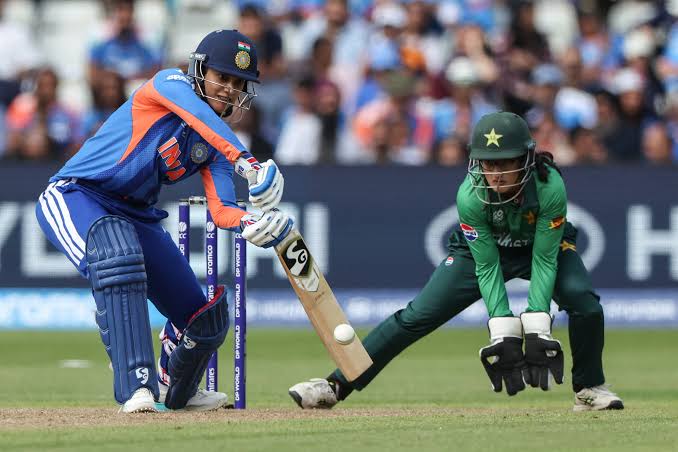

The ind vs pak women cricket rivalry has become one of the most closely followed contests in women’s international cricket. Matches between India and Pakistan attract attention not only because of the history between the two sides, but also because of the growing quality, competitiveness, and visibility of women’s cricket. Major ICC and continental tournaments have provided regular opportunities for the two teams to meet, giving fans high-profile games in which individual performances can quickly determine the outcome.
The latest chapter has produced several significant encounters in 2026. India defeated Pakistan by 64 runs in their ICC Women’s T20 World Cup group match at Edgbaston on June 14, with Smriti Mandhana scoring 68 and Deepti Sharma taking five wickets as Pakistan were dismissed for 106 after India made 170/6. The match attracted 18,814 spectators, which the ICC reported as a record attendance for a Women’s T20 World Cup group-stage match at that time.
The rivalry continued later in the year at the Women’s Asia Cup. On September 5, India bowled Pakistan out for 55 before chasing the target successfully, giving India another emphatic victory in the format. These recent results provide useful context for understanding the current ind vs pak women contest while also showing why every meeting continues to generate substantial interest.
India and Pakistan Women: A Rivalry Beyond One Match
Cricket between India and Pakistan carries a unique sporting atmosphere, and the women’s game has increasingly become an important part of that rivalry. While the players prepare for each match with the same professional objectives as any other international fixture, the wider audience often attaches additional significance to the contest.
For the players, however, preparation remains centered on familiar cricketing fundamentals. Batters need to manage pressure, bowlers have to execute their plans accurately, and fielders must maintain concentration throughout the innings. In T20 cricket especially, a small mistake can change the direction of a match within only a few overs.
The development of women’s cricket has also changed the environment surrounding these games. Bigger crowds, improved broadcast coverage, professional domestic competitions, and greater investment have helped players from both countries gain experience in high-pressure situations. The result is a contest that combines traditional rivalry with a modern, increasingly competitive women’s cricket landscape.
Recent IND vs PAK Women Results
The most recent meetings offer a clear picture of how the rivalry has developed. At the 2026 Women’s T20 World Cup in Birmingham, India posted 170/6 before dismissing Pakistan for 106. Deepti Sharma’s five-wicket haul was the standout bowling performance, while Mandhana’s 68 provided the foundation for India’s total.
India also entered that World Cup meeting with strong recent results against Pakistan. Before the Birmingham match, the ICC noted that India had won their previous three contests, including a six-wicket victory in the 2024 Women’s T20 World Cup in Dubai. icc The 2026 World Cup result extended that sequence.
A few months later, the teams met again in the 2026 Women’s Asia Cup. India restricted Pakistan to 55, their lowest-ever T20I total according to the ICC match report, and completed the chase without major difficulty. The result helped India maintain an unbeaten run in the tournament at that stage.
| Match context | India | Pakistan | Result |
|---|---|---|---|
| Women’s T20 World Cup 2026 | 170/6 | 106 all out | India won by 64 runs |
| Women’s Asia Cup 2026 | Chased 56 | 55 all out | India won by 10 wickets |
These results should be viewed within their individual tournament contexts rather than treated as a complete measure of either team’s overall ability. Different venues, conditions, squads, form, and match situations can substantially influence the next meeting.
India Women’s Current Cricketing Setup
India entered the 2026 Women’s T20 World Cup with a squad led by Harmanpreet Kaur, with Smriti Mandhana serving as vice-captain. The squad also included players such as Shafali Verma, Jemimah Rodrigues, Richa Ghosh, Deepti Sharma, Renuka Singh, Radha Yadav, Shreyanka Patil and several younger options.

The depth of India’s squad allows the team to approach matches through multiple combinations. Experienced batters can provide stability at the top and middle order, while all-rounders give the captain additional flexibility when constructing the bowling attack. India’s spin resources can also become particularly important on slower pitches, where controlling the middle overs can restrict an opponent’s scoring opportunities.
Deepti Sharma has been especially influential in recent meetings with Pakistan. Her five-wicket performance in Birmingham demonstrated how effectively a spinner can control a T20 innings when the opposition struggles to rotate the strike. India also have several aggressive batting options, meaning a strong start can quickly turn into a substantial total.
India’s broader 2026 season has also included important achievements outside this rivalry. In July, the women’s team recorded a 270-run Test victory over England at Lord’s, while in September India won the Women’s Asia Cup for a record eighth time after beating Sri Lanka in the final.
Pakistan Women’s Current Cricketing Setup
Pakistan’s women’s side has been developing a younger and increasingly flexible group of players while continuing to rely on experienced figures. Fatima Sana has been a central part of the team’s leadership structure, captaining Pakistan during the 2026 Women’s Asia Cup. The squad announced for that tournament included players such as Muneeba Ali, Gull Feroza, Shawaal Zulfiqar, Tuba Hassan, Nashra Sundhu and Sadia Iqbal. icc
Pakistan’s approach in T20 cricket has also placed emphasis on attacking intent. During the 2026 Women’s T20 World Cup, Pakistan coach Wahab Riaz spoke about encouraging fearless cricket while acknowledging that the team was still adapting to a new coaching approach.
That development process can be particularly important in high-pressure matches. Against India, Pakistan need to maintain discipline while still taking scoring opportunities. The challenge is not simply to attack; it is to select the right moments for aggression and avoid losing wickets in clusters.
Fatima Sana has shown the ability to influence matches with both bat and ball. During Pakistan’s World Cup match against South Africa, she scored an unbeaten 55 and took three wickets, demonstrating the all-round contribution expected from her leadership role.
Key Players to Watch in IND vs PAK Women Matches
India’s batting lineup contains several players capable of changing a match quickly. Smriti Mandhana’s ability to score fluently during the powerplay makes her an important part of India’s plans, while Shafali Verma can put pressure on bowlers through aggressive stroke play. Jemimah Rodrigues adds another dimension through her ability to build an innings and accelerate when required.
Deepti Sharma represents a different type of match influence. Her value comes from her ability to contribute in multiple departments, particularly with spin bowling and lower-order batting. Richa Ghosh also provides an attacking option behind the stumps and in the middle or lower order.
Pakistan have their own group of players capable of shifting momentum. Fatima Sana’s all-round skills make her particularly valuable, while players such as Muneeba Ali, Gull Feroza and Shawaal Zulfiqar provide batting options. Pakistan’s spin resources can also become important when conditions make stroke-making difficult.
In a ind vs pak women match, individual battles often become decisive. An opening batter surviving the first few overs, a spinner controlling the middle phase, or a captain successfully using an all-rounder can have an outsized effect on the final result.
How T20 Conditions Can Influence the Contest
T20 cricket leaves very little room for slow starts or extended periods of poor execution. The powerplay provides batting teams with an opportunity to score quickly, but it also gives bowlers a chance to attack with fielding restrictions in place.
The middle overs are often where spin becomes especially influential. Batters must balance the need to maintain momentum against the risk of losing wickets. For India and Pakistan, this phase can become particularly important because both sides have bowling options capable of changing the pace of an innings.
The final five overs bring another tactical challenge. Batting teams generally attempt to maximize boundary opportunities, while bowling teams rely on variations such as slower deliveries, changes of angle, and yorkers. Fielding becomes equally important because a single dropped catch or misfield can create a significant difference in a close T20 game.
Why IND vs PAK Women Matches Attract So Much Attention
The popularity of ind vs pak women fixtures is connected to several factors. The historical sporting rivalry between India and Pakistan naturally generates interest, but the women’s game has also developed its own identity. Performances from players such as Mandhana, Deepti Sharma and Fatima Sana have helped make individual stars recognizable to a wider cricket audience.
Attendance figures demonstrate the growing interest. The 2026 Women’s T20 World Cup match at Edgbaston drew 18,814 spectators, which the ICC described as the highest attendance for a group-stage match in the tournament’s history at that point.
Another reason these matches matter is their tournament context. When India and Pakistan meet during an ICC or continental competition, the result can affect group standings, momentum, qualification scenarios, or confidence. Consequently, the game is rarely viewed as an isolated fixture.
The Tactical Battle Between Bat and Ball
One of the most interesting aspects of the rivalry is the contrast between attacking batting and disciplined bowling. India’s recent victories have demonstrated the effectiveness of combining a competitive first-innings score with pressure through spin and accurate bowling. Pakistan, meanwhile, need to find ways to prevent early partnerships and build their innings without allowing India’s bowlers to dictate the tempo.

For Pakistan, the powerplay can be particularly important. Losing multiple wickets early can leave the middle order under pressure and make it difficult to establish a competitive total. Conversely, a strong opening partnership can provide the platform needed for late-innings acceleration.
India’s bowling strategy may also depend heavily on conditions. On surfaces offering grip, spin can become a major weapon. On flatter pitches, pace variations and disciplined lengths can be more valuable. This makes the location and surface an important part of the tactical equation whenever the teams meet.
The Growing Importance of Women’s Cricket
The significance of ind vs pak women extends beyond the result of a particular game. Women’s cricket has undergone considerable growth through improved professional structures, domestic competitions, international tournaments, and increasing audience interest.
India’s recent Asia Cup success illustrates that growth. The team completed an unbeaten tournament before defeating Sri Lanka by 72 runs in the final to secure its eighth Women’s Asia Cup title. Pakistan’s participation in major international tournaments similarly provides opportunities for emerging players to gain experience against elite opposition.
These competitions create a pathway for younger cricketers to become established international performers. A player who performs well against a major rival can gain confidence that carries into future matches, while teams can identify areas requiring improvement through repeated high-pressure encounters.
What Makes the Next Meeting Interesting
Every future ind vs pak women encounter will bring a different set of circumstances. Player availability, recent form, venue conditions, toss results, pitch behavior and tournament pressure can all change the balance of a match.
The teams will also continue evolving. India’s established international performers are being complemented by younger players, while Pakistan are working to develop consistency within a squad that includes several emerging names. That means historical results provide context, but they cannot determine what will happen in a future fixture.
For supporters, this continuing evolution is part of what makes the rivalry compelling. Each match creates a new opportunity for a batter to produce a memorable innings, a bowler to deliver a match-changing spell, or a young player to establish herself on the international stage.
Conclusion
The ind vs pak women rivalry represents an important part of modern women’s cricket. Recent encounters in 2026 have produced clear results, with India defeating Pakistan at the Women’s T20 World Cup and again at the Women’s Asia Cup. India’s performances have featured major contributions from players such as Smriti Mandhana and Deepti Sharma, while Pakistan continue to develop their squad and tactical approach under Fatima Sana’s leadership. At the same time, the significance of these matches goes beyond statistics. The growing crowds, international exposure, and emergence of new players demonstrate how women’s cricket continues to expand. When India and Pakistan meet, the combination of sporting history, tournament pressure, individual talent and tactical competition creates a distinctive cricketing spectacle. Future ind vs pak women fixtures will therefore remain closely watched as both teams continue building their next generation of international cricket.